Patient-specific mapping of fundus photographs to three-dimensional ocular imaging - Part 1: Raytracing#
This example contains raytracing simulations for the paper Patient-specific mapping of fundus photographs to three-dimensional ocular imaging.
Citation#
Next to citing ZOSPy, please also cite the following paper when using this example or the data provided within this example:
Haasjes, C., Vu, T. H. K., & Beenakker, J.-W. M. (2024). Patient-specific mapping of fundus photographs to three-dimensional ocular imaging. Medical Physics. https://doi.org/10.1002/mp.17576
Warranty and liability#
The presented code and data are made available for research purposes only. There is no warranty and rights can not be derived from them, as is also stated in the general license of this repository.
Import dependencies#
[1]:
import json

import matplotlib.pyplot as plt
import numpy as np
import pandas as pd
import seaborn as sns
from helpers import InputOutputAngles, get_nodal_points, get_retina_locations

import zospy as zp
[2]:
import warnings

warnings.filterwarnings("ignore", message="Header and row length mismatch")
Initialize OpticStudio#
Establishing a connection with OpticStudio through the ZOSPy library.
In this example we connect with OpticStudio in extension mode. For more extensive simulations we advise to use the standalone for a significant increase in computation performace.
[3]:
zos = zp.ZOS()
[4]:
oss = zos.connect("extension")
Define the eye model#
The used eye model is based upon clinical measurements of healthy subject.
[5]:
# navarro_geometry = {
#     "axial_length": 23.9203,  # mm
#     "cornea_thickness": 0.5,  # mm
#     "anterior_chamber_depth": 3.05,  # mm
#     "lens_thickness": 4.0,  # mm
#     "cornea_front_curvature": 7.72,  # mm
#     "cornea_front_asphericity": -0.26,
#     "cornea_back_curvature": 6.5,  # mm
#     "cornea_back_asphericity": 0,
#     "iris_radius": 0.5,  # mm
#     "lens_front_curvature": 10.2,  # mm
#     "lens_front_asphericity": -3.1316,
#     "lens_back_curvature": -6.0,  # mm
#     "lens_back_asphericity": -1,
#     "retina_curvature": -12.0,  # mm
#     "retina_asphericity": 0.0,
# }

geometry = {
    "axial_length": 24.305,  # mm
    "cornea_thickness": 0.5615,  # mm
    "anterior_chamber_depth": 3.345,  # mm
    "lens_thickness": 3.17,  # mm
    "cornea_front_curvature": 7.6967,  # mm
    "cornea_front_asphericity": -0.2304,
    "cornea_back_curvature": 6.2343,  # mm
    "cornea_back_asphericity": -0.1444,
    "iris_radius": 0.5,  # mm
    "lens_front_curvature": 10.2,  # mm
    "lens_front_asphericity": -3.1316,
    "lens_back_curvature": -5.4537,  # mm
    "lens_back_asphericity": -4.1655,
    "retina_curvature": -11.3357,  # mm
    "retina_asphericity": -0.0631,
}

geometry["vitreous_thickness"] = geometry["axial_length"] - (
    geometry["cornea_thickness"] + geometry["anterior_chamber_depth"] + geometry["lens_thickness"]
)
geometry["retina_radius_z"] = abs(geometry["retina_curvature"] / (geometry["retina_asphericity"] + 1))
geometry["retina_radius_y"] = abs(geometry["retina_curvature"] / np.sqrt(geometry["retina_asphericity"] + 1))

# For the Lamberth projection, a spherical retina needs to be used
# mean_retina_radius = np.mean([geometry["retina_radius_z"], geometry["retina_radius_y"]])
# geometry["retina_curvature"] = geometry["retina_radius_y"] = geometry[
#     "retina_radius_z"
# ] = -mean_retina_radius
# geometry["retina_asphericity"] = 0.0

refractive_indices = {  # at 543 nm (green light)
    "cornea": 1.3777,
    "aqueous": 1.3391,
    "lens": 1.4222,
    "vitreous": 1.3377,
}

with open("data/geometry.json", "w", encoding="utf-8") as f:
    json.dump(geometry, f)
Initialize the optical system in OpticStudio#
For ray tracing, a wavelength of 543 nm (in the center of the visible spectrum) is used, with input beams angles from 0° to 85° in steps of 5°.
Ray aiming (a feature of OpticStudio which shifts peripheral input beams so they pass through the center of the actual pupil) is turned off, as in ophthalmic imaging the entrance pupil is in the center of the image.
[6]:
APERTURE = zp.constants.SystemData.ZemaxApertureType.FloatByStopSize
WAVELENGTH = 0.543  # nm
FIELDS = np.arange(0, 90, 5)  # degrees with respect to the optical axis
[7]:
oss.new()
oss.make_sequential()

oss.SystemData.Aperture.ApertureType = zp.constants.SystemData.ZemaxApertureType.FloatByStopSize
oss.SystemData.Wavelengths.GetWavelength(1).Wavelength = WAVELENGTH
oss.SystemData.RayAiming.RayAiming = zp.constants.SystemData.RayAimingMethod.Off

# Add fields
for i, f in enumerate(np.array(FIELDS).astype(float)):
    if i == 0:
        oss.SystemData.Fields.GetField(1).X = 0
        oss.SystemData.Fields.GetField(1).Y = f
        oss.SystemData.Fields.GetField(1).Weight = 1
    else:
        oss.SystemData.Fields.AddField(X=0, Y=f, Weight=1)
Create the eye model#
For each of the surfaces the curvature, asphericity, thickness and refractive index is set.
[8]:
# Dummy surface, needed for calculation of input angles
input_beam = oss.LDE.InsertNewSurfaceAt(1)
input_beam.Comment = "Input beam"
input_beam.Thickness = 1.0
input_beam.DrawData.DoNotDrawThisSurface = True

cornea_front = oss.LDE.InsertNewSurfaceAt(2)
cornea_front.Comment = "Cornea Front"
cornea_front.Thickness = geometry["cornea_thickness"]
cornea_front.Radius = geometry["cornea_front_curvature"]
cornea_front.Conic = geometry["cornea_front_asphericity"]
zp.solvers.material_model(cornea_front.MaterialCell, refractive_index=refractive_indices["cornea"])

cornea_back = oss.LDE.InsertNewSurfaceAt(3)
cornea_back.Comment = "Cornea Back / Aqueous"
cornea_back.Thickness = geometry["anterior_chamber_depth"]
cornea_back.Radius = geometry["cornea_back_curvature"]
cornea_back.Conic = geometry["cornea_back_asphericity"]
zp.solvers.material_model(cornea_back.MaterialCell, refractive_index=refractive_indices["aqueous"])
cornea_back.DrawData.DoNotDrawEdgesFromThisSurface = True

pupil = oss.LDE.GetSurfaceAt(4)
assert pupil.IsStop, "Pupil must be the STOP surface."
pupil.Comment = "Pupil"
pupil.SemiDiameter = geometry["iris_radius"]
zp.solvers.material_model(pupil.MaterialCell, refractive_index=refractive_indices["aqueous"])
pupil.DrawData.DoNotDrawEdgesFromThisSurface = True

lens_front = oss.LDE.InsertNewSurfaceAt(5)
lens_front.Comment = "Lens Front"
lens_front.Thickness = geometry["lens_thickness"]
lens_front.Radius = geometry["lens_front_curvature"]
lens_front.Conic = geometry["lens_front_asphericity"]
lens_front.SemiDiameter = 4.0  # Larger diameter for visualization purposes
zp.solvers.material_model(lens_front.MaterialCell, refractive_index=refractive_indices["lens"])

lens_back = oss.LDE.InsertNewSurfaceAt(6)
lens_back.Comment = "Lens Back / Vitreous"
lens_back.Thickness = geometry["vitreous_thickness"]
lens_back.Radius = geometry["lens_back_curvature"]
lens_back.Conic = geometry["lens_back_asphericity"]
zp.solvers.material_model(lens_back.MaterialCell, refractive_index=refractive_indices["vitreous"])
lens_back.DrawData.DoNotDrawEdgesFromThisSurface = True

retina = oss.LDE.GetSurfaceAt(7)
assert retina.IsImage, "Retina must be the IMAGE surface."
retina.Comment = "Retina"
retina.Radius = geometry["retina_curvature"]
retina.Conic = geometry["retina_asphericity"]
retina.Thickness = 0
# Set the refractive index of the retina to the vitreous to prevent reflections
zp.solvers.material_model(retina.MaterialCell, refractive_index=refractive_indices["vitreous"])

# Modify the settings for the visualization of the system
for i in range(1, oss.LDE.NumberOfSurfaces + 1):
    oss.LDE.GetSurfaceAt(i).DrawData.DrawEdgesAs = zp.constants.Editors.LDE.SurfaceEdgeDraw.Flat
Display the eye model in OpticStudio.
[9]:
_ = zp.analyses.systemviewers.Viewer3D().run(oss)

Perform ray tracing#
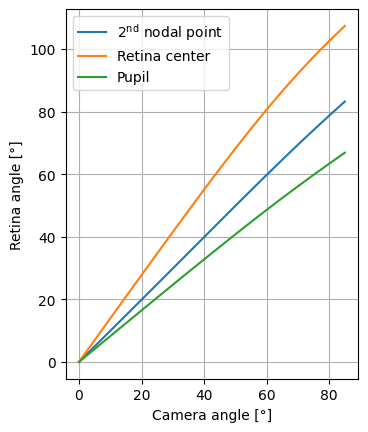
Rays are traced from the light source (the camera) to retina, for the different fields that have been configured in OpticStudio.
The results are evaluated in terms of camera angles and retinal angles. For the latter three reference points are compared: the second nodal point, the retinal center and the pupil.
[10]:
ray_trace_results = {}
input_output_angles = []

# Nodal points are calculated in OpticStudio, but can also be calculated analytically
np1, np2 = get_nodal_points(oss)

for i in range(1, oss.SystemData.Fields.NumberOfFields + 1):
    y_angle = oss.SystemData.Fields.GetField(i).Y
    ray_trace_results[y_angle] = zp.analyses.raysandspots.SingleRayTrace(
        px=0, py=0, field=i, global_coordinates=True
    ).run(oss)
    ray_trace_results[y_angle].data.real_ray_trace_data["InputAngle"] = y_angle

    input_output_angles.append(
        InputOutputAngles.from_ray_trace_result(
            ray_trace_results[y_angle],
            y_angle,
            np2=np2,
            np2_navarro=np2,
            retina_center=(
                geometry["lens_thickness"]
                + geometry["vitreous_thickness"]
                - (abs(geometry["retina_curvature"] / (geometry["retina_asphericity"] + 1)))
            ),
            patient="Patient1",
        )
    )

real_ray_trace_results = pd.concat(r.data.real_ray_trace_data for r in ray_trace_results.values())
input_output_angles = pd.DataFrame(input_output_angles)
Add the retinal locations to the dataframe
[11]:
input_output_angles["retina_location"] = input_output_angles.apply(
    lambda r: get_retina_locations(r, real_ray_trace_results), axis=1
)

input_output_angles
[11]:
| input_angle_field | input_angle_cornea | input_angle_pupil | output_angle_pupil | output_angle_np2 | output_angle_retina_center | output_angle_navarro_np2 | location_np2 | location_retina_center | patient | retina_location | |
|---|---|---|---|---|---|---|---|---|---|---|---|
| 0 | 0.0 | 0.0 | 0.000000 | 0.000000 | 0.000000 | 0.000000 | 0.000000 | 3.457872 | 8.299343 | Patient1 | (20.3985, 0.0) |
| 1 | 10.0 | 10.0 | 8.559338 | 8.236620 | 9.924741 | 13.887107 | 9.924741 | 3.457872 | 8.299343 | Patient1 | (20.022129705, 2.8982969683) |
| 2 | 20.0 | 20.0 | 17.125957 | 16.461583 | 19.876188 | 27.752562 | 19.876188 | 3.457872 | 8.299343 | Patient1 | (18.929358005, 5.5933282836) |
| 3 | 30.0 | 30.0 | 25.710515 | 24.653892 | 29.866615 | 41.532014 | 29.866615 | 3.457872 | 8.299343 | Patient1 | (17.225415858, 7.9060177623) |
| 4 | 40.0 | 40.0 | 34.330320 | 32.778578 | 39.883907 | 55.092636 | 39.883907 | 3.457872 | 8.299343 | Patient1 | (15.071429925, 9.7049004243) |
| 5 | 50.0 | 50.0 | 43.012066 | 40.784670 | 49.883060 | 68.229900 | 49.883060 | 3.457872 | 8.299343 | Patient1 | (12.661808084, 10.923468966) |
| 6 | 60.0 | 60.0 | 51.792984 | 48.602608 | 59.775819 | 80.686513 | 59.775819 | 3.457872 | 8.299343 | Patient1 | (10.196207912, 11.566389056) |
| 7 | 70.0 | 70.0 | 60.718906 | 56.149161 | 69.430824 | 92.200759 | 69.430824 | 3.457872 | 8.299343 | Patient1 | (7.8495996064, 11.703115207) |
| 8 | 80.0 | 80.0 | 69.838344 | 63.373162 | 78.731841 | 102.612037 | 78.731841 | 3.457872 | 8.299343 | Patient1 | (5.7383659648, 11.445857555) |
| 9 | 5.0 | 5.0 | 4.279254 | 4.118911 | 4.960514 | 6.944355 | 4.960514 | 3.457872 | 8.299343 | Patient1 | (20.303833183, 1.4621330149) |
| 10 | 15.0 | 15.0 | 12.841190 | 12.351573 | 14.895882 | 20.825151 | 14.895882 | 3.457872 | 8.299343 | Patient1 | (19.560230904, 4.2832673229) |
| 11 | 25.0 | 25.0 | 21.415104 | 20.563653 | 24.866623 | 34.659589 | 24.866623 | 3.457872 | 8.299343 | Patient1 | (18.144798235, 6.8070476922) |
| 12 | 35.0 | 35.0 | 30.014588 | 28.727470 | 34.873829 | 48.350894 | 34.873829 | 3.457872 | 8.299343 | Patient1 | (16.192992149, 8.8754977161) |
| 13 | 45.0 | 45.0 | 38.661366 | 36.800334 | 44.890134 | 61.729413 | 44.890134 | 3.457872 | 8.299343 | Patient1 | (13.885875539, 10.388088262) |
| 14 | 55.0 | 55.0 | 47.387416 | 44.722252 | 54.850162 | 74.560403 | 54.850162 | 3.457872 | 8.299343 | Patient1 | (11.424123782, 11.313897756) |
| 15 | 65.0 | 65.0 | 56.234756 | 52.414799 | 64.642057 | 86.575621 | 64.642057 | 3.457872 | 8.299343 | Patient1 | (8.9989454527, 11.691614612) |
| 16 | 75.0 | 75.0 | 65.251528 | 59.800635 | 74.128488 | 97.546003 | 74.128488 | 3.457872 | 8.299343 | Patient1 | (6.7605642505, 11.616108718) |
| 17 | 85.0 | 85.0 | 74.484459 | 66.881087 | 83.250187 | 107.415926 | 83.250187 | 3.457872 | 8.299343 | Patient1 | (4.7841584997, 11.206051257) |
Save the output
[12]:
real_ray_trace_results.to_csv("data/ray_trace_results.csv", index=False)
input_output_angles.to_csv("data/input_output_angles.csv", index=False)
Plot the relations between input angles (camera angles) and output angles (retinal angles)
[13]:
fig, ax = plt.subplots()

sns.lineplot(
    data=input_output_angles,
    x="input_angle_field",
    y="output_angle_np2",
    label="$2^{\\mathrm{nd}}$ nodal point",
)
sns.lineplot(
    data=input_output_angles,
    x="input_angle_field",
    y="output_angle_retina_center",
    label="Retina center",
)
sns.lineplot(
    data=input_output_angles,
    x="input_angle_field",
    y="output_angle_pupil",
    label="Pupil",
)

ax.set_xlabel("Camera angle [°]")
ax.set_ylabel("Retina angle [°]")
ax.set_aspect("equal")
ax.grid()